
Services › Telecommunications
Telecommunications
Testing, deploying and operating networks, from fibre links and cellular sites to enterprise voice and collaboration.
Request a quote Explore services
What this category covers
Testing, deploying and operating networks, from fibre links and cellular sites to enterprise voice and collaboration.
Telecommunications Testing & Validation
Auditing signal integrity, network latency, and fiber optic throughput.
Full-lifecycle empirical analysis, physical-layer characterization and protocol conformance testing for optical transport, satellite links, microwave backhaul and cellular core interfaces.

Typical use cases
- Fibre link acceptance
- Coverage and signal surveys
- Latency and throughput audits
What you receive
- Test plan and method
- Measured results with pass / fail
- Remediation recommendations
Sub-service delivery modules
Multi-wavelength bidirectional OTDR analysis, chromatic dispersion (CD) profiling and polarization mode dispersion (PMD) evaluation to qualify dark fiber for high-count DWDM networks.
Line-rate throughput stress tests with packet validation to verify Carrier Ethernet SLAs.
Over-the-air monitoring to isolate noise floors, passive intermodulation (PIM) and unauthorized interference.
Platforms, frameworks & standards
Target outcomes & service levels
- Detect line anomalies down to ≤ 0.05 dB splice loss
- Bit Error Rate (BER) target ≤ 10⁻¹² on transport rings
- Audit-ready optical link maps within 48 hours of inspection
Service levels are targets; final commitments are defined in each statement of work.
Operators and enterprises validating links and coverage before or after launch.
Define targets and methods
Run signal, latency and optical tests
Compare results with targets
Recommend fixes and retest
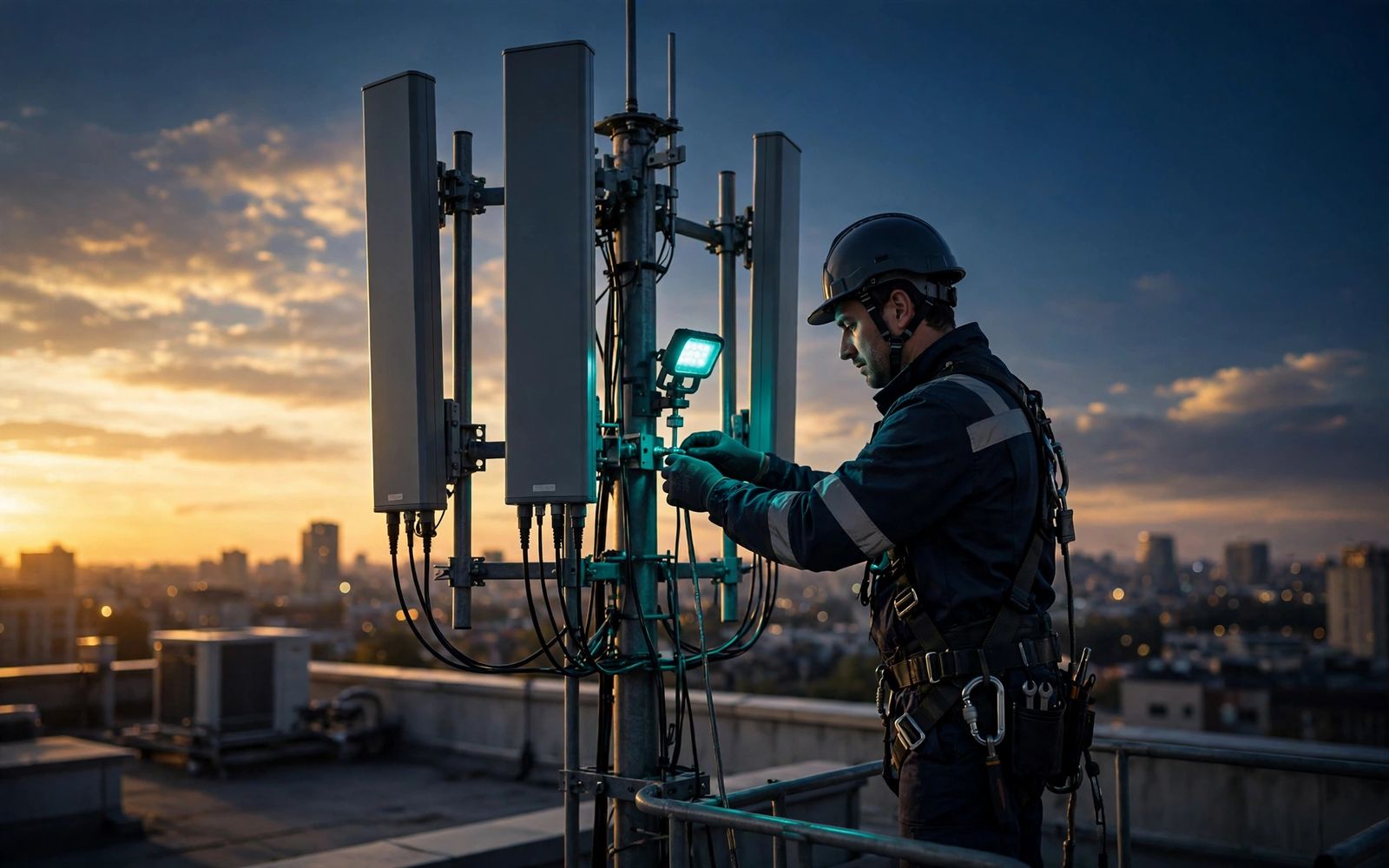
5G/LTE Network Deployment
Installing cellular base stations and configuring radio access networks.
Structural design, physical implementation, configuration and radio cell densification for public carrier expansions and standalone private 5G networks.
Typical use cases
- New site rollout
- Capacity upgrades
- Private LTE / 5G networks
What you receive
- Survey and RF plan
- Commissioned base stations
- Acceptance test report
Sub-service delivery modules
3D GIS terrain simulation to map signal paths, determine tower placements and calculate antenna tilts.
Mounting, grounding and power coupling of gNodeB/eNodeB hardware, Remote Radio Heads (RRH) and Baseband Units (BBU).
Software-defined slicing in the 5G Core (5GC) to split traffic into logical channels for distinct mission-critical tasks.
Platforms, frameworks & standards
Target outcomes & service levels
- Design for massive machine-type communications (mMTC), up to 1,000,000 devices/km² as defined in the 5G specification
- URLLC air-interface latency target ≤ 1 ms
- Link-availability benchmark targeted at up to 99.999%
Service levels are targets; final commitments are defined in each statement of work.
Operators and enterprises extending or building cellular coverage.
Assess sites and RF conditions
Design radio and backhaul
Mount and commission equipment
Tune parameters and accept
VoIP & Unified Communications Setup
Implementing enterprise IP-telephony and digital communication platforms.
Migration architecture, deployment and SIP trunk optimization that turns legacy analog PBX components into a consolidated, cloud-accessible communication layer.

Typical use cases
- Replacing a legacy PBX
- Multi-site calling
- Basic contact-centre setups
What you receive
- Call-flow design
- Configured platform and handsets
- Admin and user training
Sub-service delivery modules
Enterprise session controllers that route concurrent external voice lanes while mitigating denial-of-service attempts.
Multi-tier IVR maps, hunt groups, time-based routing and E911 location mapping.
Desktop, mobile and room endpoints that merge voice, chat and video in a single console.
Platforms, frameworks & standards
Target outcomes & service levels
- Mean Opinion Score (MOS) target ≥ 4.2
- Packet jitter ≤ 20 ms
- Automated trunk failover within ≤ 500 ms of primary carrier loss
Service levels are targets; final commitments are defined in each statement of work.
Businesses replacing phone systems or connecting several offices.
Map users, numbers and call flows
Set up platform, trunks and devices
Port numbers and switch over
Support users after go-live
Ways to work with us
Choose the model that fits your project and budget.
Project
A defined scope, timeline and deliverables for a specific outcome, such as a build, deployment or assessment.
Ongoing support
Continuing maintenance, monitoring or helpdesk cover agreed in writing after the initial delivery.
Consulting
Expert advice, reviews and roadmaps when you need direction before committing to a build.
How we work
The same four steps apply to every service in this category.
We learn your goals, constraints and current setup.
You receive a scoped proposal with timeline and cost.
Our engineers build, configure and test the solution.
Handover, documentation and ongoing help.
What you can count on
Clear scope
A written proposal covering work, timeline and cost before we start.
Tested delivery
Everything is tested against agreed criteria before handover.
Documentation
You receive the diagrams, configurations and files needed to run what we build.
Support after go-live
Optional ongoing support so issues do not fall on your team alone.
Industries we support
Our Telecommunications services are used across sectors such as:
Frequently asked questions
Do you provide site surveys?
Yes. Surveys and measurements come first so deployments match real conditions.
Can you test a live network?
Yes. We measure and report against your targets, avoiding disruption to live service wherever possible.
Technical Engagement & Scopes
Ready to optimize or integrate these technical models into your organization? Contact our Central Engineering & Solutions Architecture Board to schedule a deep architectural discovery session.
Tell us what you need
Share a few details and an engineer will reply by email.